It’s tRUe! April 25th Classics Greek & Roman Fashion Show combines forces with LVDVS MAGNVS GLADIATORES

0rudaybannerActually, this ain’t no toga party…this is historically accurate merch

Rutgers Day is now less than three weeks away—Saturday 25 April to be specific, in New Brunswick. It’s billed as a free “family, friendly, fun exhibition of all of the things we do at Rutgers–our teaching, our research, and our service to the state of New Jersey.” Learn all about Rutgers Day here.
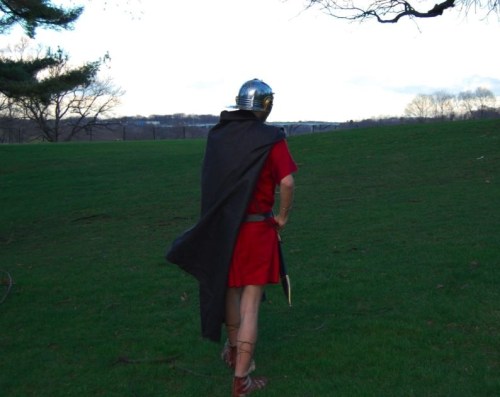
goldinOn 25 April, all roads  lead to Rutgers. This legionary (RU’11) is already here.

As everyone in the Garden State should know by now, Rutgers Classics is hosting a Greek and Roman fashion show for that day. It’s set to dominate the very center of the College Avenue Campus, on the steps of Brower Commons—with a red carpet runway extending 60 Roman feet.
green4

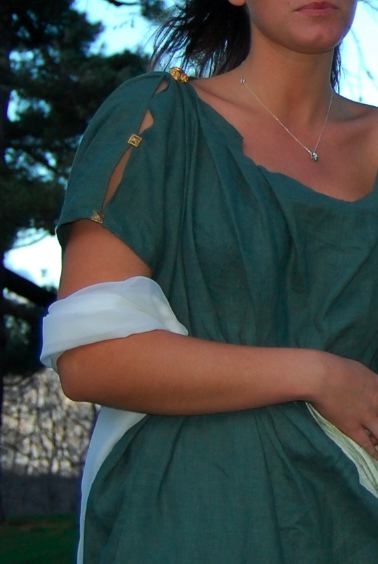
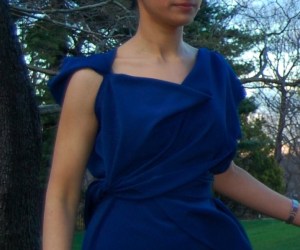
Designer Jessica Deschamps has been working around the clock on a drop-dead line of Roman couture. And at a recent fitting, some of Rutgers’ top ancient models practiced their fiercest runway moves to a thumping DJ Korenelius soundtrack. On Rutgers Day itself there will be four five shows in all: 10.30 11.00 AM, and 12.00, 1.00 (gladiator gala!), 1.30 2.00, and 3.00 PM.
6blue217red1

But hold onto your seat. Also featured that day will be none other than—Ludus Magnus Gladiatores. For a glimpse into their story (and an amazing video by James Duffy) click here.
1rmd013

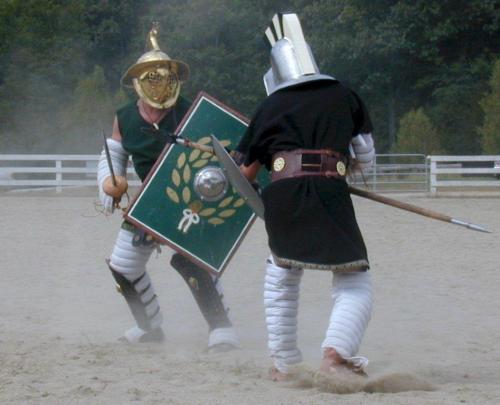
The Ludus Magnus Gladiatores is an AD 87 Roman reenacting group based mostly in NY and NJ. There are only a few such gladiatorial units in America. But these folks also happen to be the best in the nation, perhaps in the world. [I’m hardly going to argue with that—Ed.]

Founded in 2003, the members of the Ludus Magnus Gladiatores are all heavily invested in creating near-perfect reproduction Roman arena gear. And then they fight each other in full combat, with impeccable gladiatorial technique. The swords are wooden—just like in the old Roman Ludus Magnus, or gladiatorial training school. Everything else is very real.
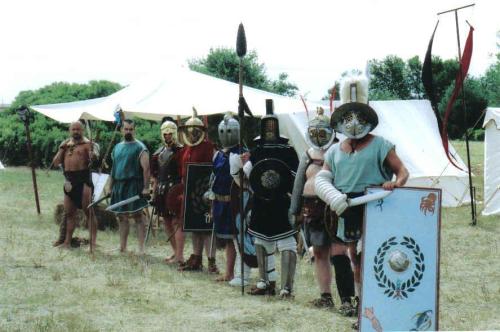
2ludusgroup1

“When we dress and engage, we are from the first century AD”, says Summus Palus (and founder and leader) John J. Ebel, Esq. of East Hampton NY. “Our civilian ladies and ‘Vestal Virgins’ are also perfect in impressions, as are the younger children, who also participate, in clothing appropriate to the time….All of my gang are coming [to Rutgers Day], and I mean full attendance.”

The Ludus Magnus aims—as it says on its daunting Membership Application Form—“to educate the public about the reality of gladiatorial combat, training, and lifestyle, as well as dispel many of the widely-held myths and misconceptions about this fascinating aspect of antiquity”. Oh, and put on a jaw-dropping show that will complement and enhance the high fashion event of the last two millennia.

8retiarius-murmillofight3

It’s probably never happened before in history, ancient or modern. A blazing Greek & Roman fashion show matched with hyper-authentic gladiatorial combat. Excited? Intrigued? Click here to join the Facebook group RU Classics Greek & Roman Fashion Show @ Rutgers Day 4.25.09. And stay tuned to this blog for more details as they emerge in the (few) weeks to come.

9facebookgroupinvite[OK, but that jewelry looks distinctly Sumerian to me—Ed.]

RU Classics grad student Kathleen Shea wins 2009/10 appointment as Rutgers-Newark Scholar/Teacher

Kathleen Shea has been selected as a member of the second annual class of the Rutgers Scholar-Teachers at Rutgers—Newark for the academic year 2009-2010. The Scholar-Teachers program was developed to place some of the very best advanced doctoral students in the Humanities at Rutgers’ New Brunswick campus in classrooms in Newark. There are just five such positions awarded this year.

sheanewark
Kate’s appointment will be in Classics, which at Newark is administered by the Department of History. There over the course of the year she will teach a combination of four introductory and elective courses in the field.

After receiving her BA in Classics from the University of Oregon, Kate worked briefly in the corporate world before starting the Classics PhD program at Rutgers. Her interests lie mostly in Latin literature, especially Catullus and the erotic poetry of the Augustan age, all against the Hellenistic background. Kate’s dissertation project is on Ovid’s Amores and spectacularity in the urban fabric.

An unusually experienced and gifted teacher, Kate last year served as head Teaching Assistant for Rutgers introductory Latin, with supervisory responsibilities for five sections and over 100 students.

This past fall there appeared as a stand-alone issue of the American Journal of Ancient History an edition of the (previously unpublished) autobiography of T.R.S. Broughton (1900-1993), for which Kate served as co-editor. Plus, for two years, while continuing her studies at Rutgers, Kate served as a full time head college librarian—namely, as Librarian of the Glorious People’s Library at Deep Springs College (California).

Rutgers Classics has seen its students win a Scholar-Teacher award for each of the two years of the Program’s existence. Currently teaching at Newark as a Scholar-Teacher is Classics graduate student Liz Gloyn.

800px-rutgers-newarkCredit: Wikipedia Commons

Serena Connolly receives 2009/10 Mellon Fellowship for Assistant Professors at Institute for Advanced Study

Serena Connolly, who is now in her second year on the faculty of Rutgers Classics, will spend academic year 2009/10 as a Member of the Institute for Advanced Study in Princeton. Connolly has received a Mellon Fellowship for Assistant Professors in the School of Historical Studies at the IAS. Connolly is just one of three scholars from North America to receive this highly competitive Fellowship for next year.

connollyias2

Connolly’s IAS project is “Cato’s Dicta: Roman Society and the Individual”. This is the first book-length examination of the Disticha Catonis—an Imperial collection of Latin aphorisms—in their classical context.

“They were a fundamental text for medieval schoolchildren,” writes Connolly, “when they, and the name of Cato along with them, became a byword for wisdom. Translated into at least fourteen languages between the tenth and fourteenth centuries, the Dicta were not only one of the earliest texts to be printed by Caxton, but also the first Classical work in translation to be printed in North America.”

But beneath the surface—and this new analysis is Connolly’s contribution—“they offer us a rare opportunity to explore how Romans thought an individual should live in Roman society on the threshold of the ascendancy of Christianity”.

Serena Connolly is a graduate of Cambridge (BA 1998) and Yale (PhD 2004), where she taught for three years before coming to Rutgers Classics in 2007. She currently serves as the Department’s Director of Graduate Studies.

In 2009 Connolly will see the publication of her first book, Lives behind the Laws: the World of the Codex Hermogenianus (Indiana University Press). In this she explores the social, political and legal significance of the system of petition and response.

Next month Connolly appears at the Association of Ancient Historians’ Annual Meeting in Vancouver BC (14-16 May) , speaking on “Trouble and Strife in Roman Marriage”.

fuldhall2Fuld Hall at the IAS in 1947. Credit: Alfred Eisenstaedt/LIFE

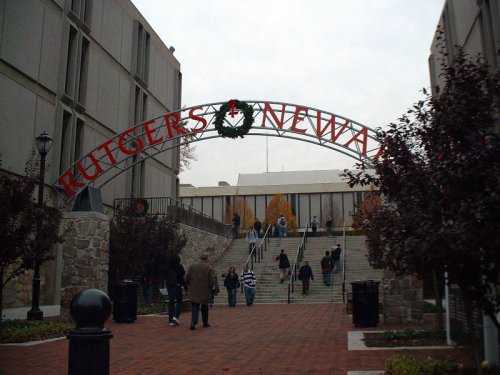
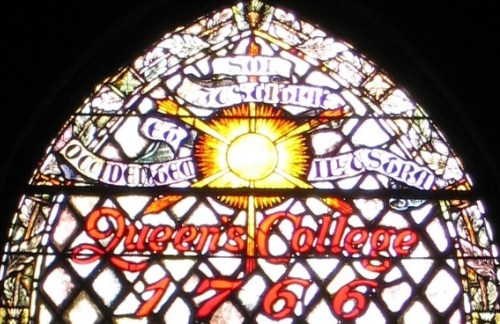
A 60 second RU history lesson: the Rutgers Latin motto ‘Sol iustitiae et occidentem illustra’

charterwindowThe Charter Window in Rutgers’ Kirkpatrick Chapel

Better late than never.

As it so happens, yesterday—26 March 2009—marked the 373rd anniversary of the founding of the University of Utrecht in the Netherlands. Perhaps you celebrated it. If not, here’s a 60 second history spot on why it matters for Rutgers folks…

On 26 March 1636, goes the story, Utrecht’s students saw their two year old “Illustrious School”—sort of like a medieval junior college—upgraded to university status. From that point on they were able to obtain academic and doctoral degrees—and (among other privileges) to escape taxes on beer and wine.

Now here is where we must turn to a 1995 pamphlet by Roelof van den Broek, Hy leeret ende beschuttet. Over het wapen en de zinspreuk van de Universiteit Utrecht, which Professor Leen Dorsman, official Historian of Utrecht University, generously summarized for the benefit of Rutgers Classics.

Already from its start in 1634 the Illustrious School seems to have used a sun emblem with Latin motto ‘Sol Iustitiae Illustra Nos‘ (“Sun of Righteousness, Enlighten Us”). For instance, the professor of classical studies (Justus Liraeus) used the phrase in his inaugural lecture. Perhaps the verb “illustra” was meant to evoke the “Illustrious School” itself.

In any case, on Opening Day in 1636, Utrecht University’s first “Rector Magnificus” was presented with those visuals and text on the official seals and crest of the new university.

The points shooting out from the sun in the contemporary Utrecht logo are in fact not sunrays but stylized flames. In the emblem of the original 17th century Sol one can also see some small engraved lines between the flames: those represent the rays of the sun. This all goes back to an older tradition in which God was presented as a sun with flames and rays (i.e., the power to both burn and radiate). The shield in the center of the sun is that of the town of Utrecht.

And here is where the Rutgers angle comes in. The seal of Rutgers (est. 1766 as Queen’s College) is directly adapted from that of Utrecht, but without the town shield, and with a slightly altered motto: ‘Sol Iustitiae Et Occidentem Illustra‘ (“Sun of Righteousness, Enlighten also the West”). The Latin is a conflation of the Biblical texts of Malachi 4:2 and Matthew 13:43.

twologos1

Now, the ‘Illustra‘ motto is not found in the earliest charter of our university, dated 20 March 1770. [That’s another anniversary that you just missed—Ed.]

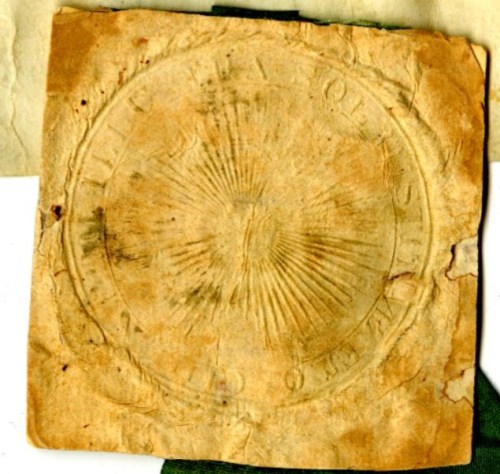
However it does show up on the earliest extant Rutgers diploma, which is that of Simeon DeWitt, Class of 1776.

dewitt2Seal from the diploma of Simeon DeWitt, Class of 1776, with “Sun of Righteousness” and Latin motto. Credit: Thomas Frusciano / Rutgers Special Collections and University Archives

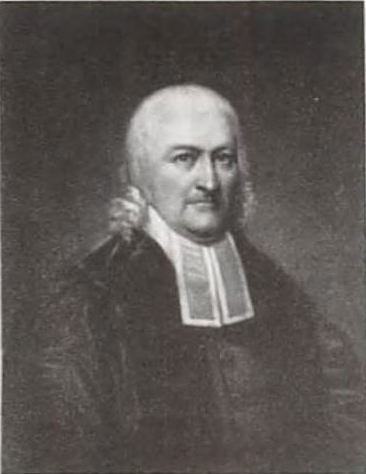
So it certainly does go back to the earliest decades of the institution. Indeed, it was almost certainly one Rev. John H. Livingston (1746-1825) who suggested that Queen’s College adopt the Utrecht seal and motto.

livingston

The Reverend John Henry Livingston, president of Rutgers 1810-1825

But there’s just a bit more to say… Continue reading

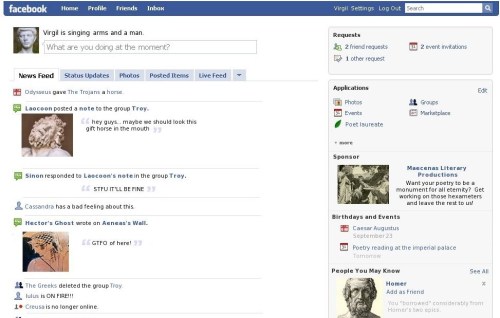
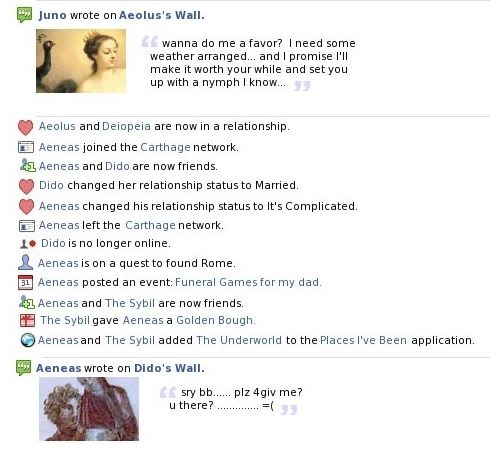
RU Classics luvs LOL’able Facebook ‘Aeneid’

For parodies of Vergil, the Golden Age really was the seventeenth and eighteenth centuries.

Or so it seemed, until University of Maryland Classics grad students Erika Grace Carlson and Heather Day dropped their Facebook Aeneid on a wholly unprepared world.

aenfacebook1

Midway through the first week of March, Facebook Aeneid had gone completely viral here at Rutgers Classics. Many undergraduates termed it “genius” (often with further modifiers).

Indeed, for Carlson and Day to get across much of the narrative and tone of Vergil’s Aeneid in something like 300 words does take brilliance. Especially while simultaneously summing up the content of the better part of 175 200 million Facebook pages.

The Rutgers Classics Department Blog was determined to find out the background to this coup. So here is Erika Carlson telling the story of the duo in an exclusive interview…

RU: Can you tell our millions of readers a bit about yourselves?

EGC: Heather and I are both grad students in the Master’s program at University of Maryland. Last semester, we bonded over our pasts at small liberal arts colleges (her past at Wheaton, mine at Bryn Mawr), our shared love of BBC America, and our similar senses of humor. While Heather wants to teach high school Latin, and I’m aiming for a PhD so I can eventually teach Classics at the college level, we’re both very concerned with finding ways to reach out to our students, present and future.

aenfacebook2RU: How on earth did you get the idea for the Aeneid Facebook parody?

EGC: Admittedly we’d seen fake Facebook feeds before—there was one that retold Hamlet which served as our primary inspiration.

But we figured, why should we let English majors have all the fun? Greek and Roman literature seemed just as, if not more, rich with incidents that could be easily translated into internet drama. At first our discussion was mostly hypothetical—if we could take a Classical text and make it into a Facebook feed, which one would work best?—but by the time we’d worked out that Aeneas and Dido were an “It’s Complicated” on Facebook, we were pretty sold on the idea.

hay_carlsonMaryland Classics grad students Heather Day (left) and Erika Carlson

RU: How long did it take you to put the Aeneid Facebook page together?

EGC: The text took about an hour and a half, and we finished that early last November. Making the photoshopped image took a few months after that, because I’d work on it for an hour or two at a time on select weekends. Admittedly, I was being a bit of a perfectionist in trying getting the look just right, and dragging my feet. Fortunately, Heather was TAing myth during Maryland’s winter semester, and gave me an ultimatum to finish it on Inauguration Day, so I got it finished just in time for the Aeneid lesson.  Heather distributed it to her students in paper form the very next day. Continue reading

Tenure-track positions at RIC, Vanderbilt for RU Classics PhDs Golden, Johnson

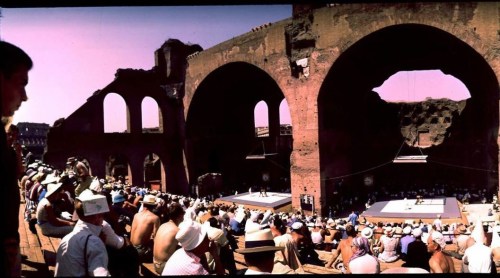
maxentiusGreco-Roman wrestling at the Basilica of Maxentius, Rome Olympics, August 1960. Credit: George Silk/LIFE

Perhaps no year in recent decades has posed more of a struggle for academic job seekers that the current one. And for PhDs in Classics and Archaeology, the 2008/9 season has proved especially tough.

So it’s doubly good news that in the last weeks two recent Rutgers PhDs in Classics have landed highly desirable tenure-track positions. [Is this true? I haven’t seen it in Famae Volent—Ed.]

Gregory K. Golden (BA Penn, MA Chicago, MLitt Oxford [New College], PhD 2008 Rutgers) will join the History faculty of Rhode Island College (Providence RI) as an assistant professor. This current year Greg has been teaching Western Civilization for the Rutgers-Newark Department of History as well as Medieval Latin for Rutgers-New Brunswick Classics.

Michael Johnson (BA Truman State, MA UNC-Chapel Hill, Fellow of the American Academy in Rome’07, PhD 2007 Rutgers) moves to Nashville TN in September 2009 to start as an assistant professor of Classical Studies at Vanderbilt University. Mike is presently in his second year as Visiting Assistant Professor at Davidson College in North Carolina.

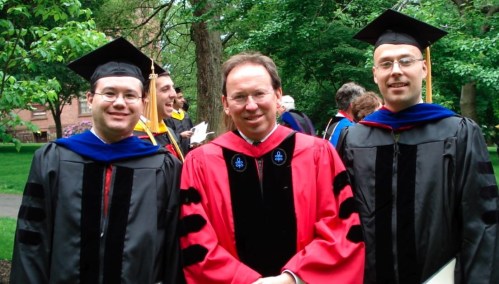
goldenbrennanjohnsonRU Commencement May 08, from left: Golden, TC Brennan, Johnson

Here’s a factoid worth noting. All Rutgers PhDs in Classics this decade have received immediately on graduation an academic appointment in their field. As of September 2009 virtually all will be tenured or tenure track. Here’s the roster:

PhD 2008 Ryan C. Fowler
Dissertation: “The Platonic Rhetor in the Second Sophistic”
Now: Grinnell College, Visiting Assistant Professor, Classics and Philosophy

PhD 2008 Gregory K.Golden
Dissertation: “Emergency Measures: Crisis and Response in the Roman Republic (from the Gallic Sack to the Tumultus of 43 BC)”
Now: Rutgers University, Instructor, History and Classics
Soon: Rhode Island College, Assistant Professor, History (from Sep. 2009)

PhD 2008 Andrew G. Scott
Dissertation: “Change and Discontinuity within the Severan Dynasty: The Case of Macrinus”
Now: Hendrix College, Assistant Professor, Classics

PhD 2007 Michael Johnson (FAAR’07)
Dissertation: “The Pontifical Law of the Roman Republic”
Now: Davidson College, Visiting Assistant Professor, Classics
Soon: Vanderbilt University, Assistant Professor, Classical Studies (from Sep. 2009)

PhD 2004 Debra Lynn Nousek
Dissertation: “Narrative style and genre in Caesar’s Bellum Gallicum
Now: University of Western Ontario, Assistant Professor, Classical Studies

PhD 2003 Lawrence Melvin Kowerski III
Dissertation: “Simonides on the Persian Wars: a study of the elegiac verses of the ‘New Simonides’”
Published as: Simonides on the Persian Wars: a study of the elegiac verses of the “New Simonides” (Routledge 2005)
Now: Hunter College (CUNY): Associate Professor of Classics

PhD 2002 Karen E. Klaiber Hersch (FAAR’01)
Dissertation: “Nuptiae Romanae: the wedding ceremony in Roman literature and culture”
Now: Temple University: Assistant Professor of Greek and Roman Classics

PhD 2002 Ilaria Marchesi
Dissertation: “A complex prose: the poetics of allusion in the epistles of Pliny the Younger”.
Published as: The art of Pliny’s letters: a poetics of allusion in the private correspondence (Cambridge University Press/America 2008)
Now: Hofstra University: Associate Professor of Classics and Comparative Literature

And joining the ranks of Rutgers PhDs in May 2009…

Christopher Marchetti
“Aristoxenus’ Elements of Rhythm: Text, Translation, and Commentary” (defended 6 March 09)
Now: Flint Hill School (Oakton VA), Upper School Classics Teacher

For information on the Rutgers graduate program in Classics, contact the Graduate Director, Professor Serena Connolly.

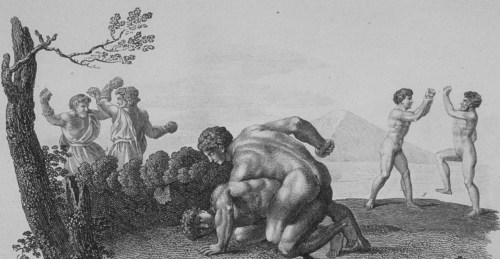
romanwrestlingFrom A.J. Mitterbacher, Das Kriegswesen der Römer (Prague 1824)

Now in 5th year, Rutgers Summer Program in Greece better than ever for 2009

clairmontgreece1Credit: Christoph Clairmont

And here’s yet another RU anniversary worth noting…

This year marks the fifth consecutive time that Rutgers University will run its Summer Program to Greece. This year’s dates are from 6 July to 10 August.

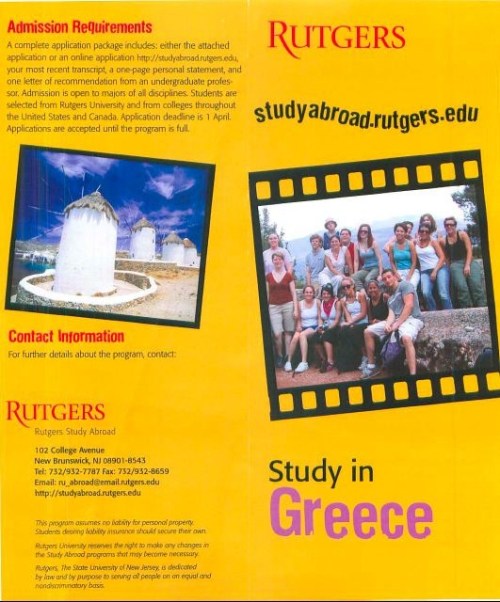
For this five week course, students earn six credits: three in History and three in Classics. Majors in any subject are welcome. Language of instruction is English. You can download a brochure and application here.
rugreece
In this undergraduate travel program students spend about half the time in Athens, with expert guided tours of the National Archaeological Museum, the Agora Museum, the Byzantine Museum, and the Benaki.

The other half of the course takes place outside Athens—Crete, the Peloponnese, and northern Greece (including Delphi, Thessaloniki, and the monastery at Meteora).

While in Athens participants stay in and use facilities provided by College Year in Athens (shared rooms with kitchens). Outside of Athens the lodgings are carefully selected hotels, with the occasional overnight ferry.

You will have three experienced professors guiding you throughout the course, whose specialties range from ancient Greek through Byzantine history. Directing the Program is Professor Gary Farney, from Rutgers University-Newark, who runs its Program in Ancient and Medieval Civilizations, and has been with the RU Greece program in each of its five years. Also returning is Professor Dylan Bloy, Gettysburg College, a specialist in Greek and Roman interactions, with extensive archaeological field experience in mainland Greece and Crete. And rounding out the triumvirate is Professor Stephen Reinert, an expert in Byzantine history, who is no less that the Dean of the Rutgers Study Abroad Program.

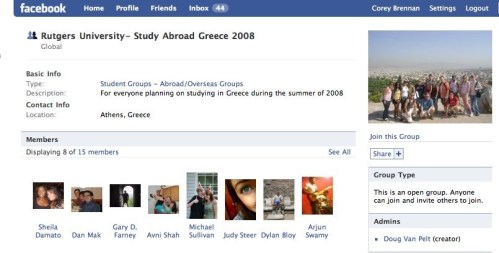
facebookgreeceFrom the Facebook group for participants on the 2008 RU Greece program

But wait…there’s more! Continue reading

RU ready for 25 April? Classics Greek & Roman Fashion Show gets prime Rutgers Day site, Facebook group

romfashion2Sorry guys—you didn’t preregister to model at the RU Classics Fashion Show

It’s coming up quick.

Rutgers Day is just over a month and a half away—Saturday 25 April to be specific. It’s billed as “a family, friendly, fun exhibition of all of the things we do at Rutgers–our teaching, our research, and our service to the state of New Jersey. We are inviting the citizens of New Jersey to come to New Brunswick, visit the campus, and see what we do.”

Oh yeah, and it’s free. In all there are 380 programs, including performances, workshops, mini-lectures, demonstrations, info booths, lots of children’s activities, plus Ag Field Day and the 35th annual NJ Folk Festival.

If the weather’s good, a crowd of 40,000 or 50,000 is expected. Learn all about Rutgers Day here.

And what’s Rutgers Classics doing on this dynamite day?  The obvious thing: hosting a Greek and Roman fashion show.

deschamps1

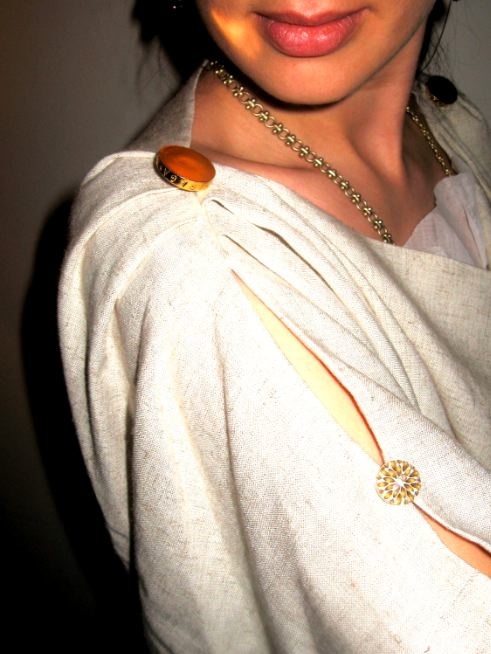
dress2aFrom the Spring 09 Rutgers Roman women’s line, as designed by J. Deschamps

It all goes down in the very center of the College Avenue Campus, on the steps of Brower Commons—with a red carpet runway extending 60 Roman feet. (Pity the program taking place simultaneously across the street: “Meet the NFL Players”.)

cf4The Greek and Roman Runway @ Brower Commons

Students and departmental friends will be making and/or modelling some of the most historically accurate classical merch that’s been seen on our planet since the days of Herodes Atticus.

And that’s not all. DJ Korenelius will spin and emcee at this hyperbolic event. Hear his Rutgers Day promo here.

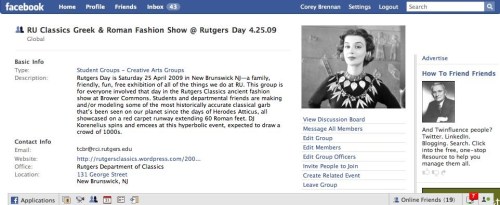
And click here to join the Facebook group RU Classics Greek & Roman Fashion Show @ Rutgers Day 4.25.09. The group provides all the latest “Project Runway 29 BC” news and photos, and (coming soon) some exclusive DJ Korenelius stress edits. [What’s a “stress edit”?—Ed.]

facebookpage

Do you want to help make the clothes? Do you want to model them? Do you want to do both? Call 732.932.9493 or email here.

Expected to become an annual event, the first-ever Rutgers Day action begins that Saturday 25 April at 10 AM and ends at 4 PM. More news soon to come!

ruclassicsfashionbanner

rutgersdayflyerCheck out Line 8—that’s us!

A RU anniversary: Project Theophrastus and RUSCH still going forward—and no end in sight

theoportrait2

Here’s an anniversary certainly worth noting. It was in 1979 that Project Theophrastus was founded at Rutgers University.

And now thirty years on, its director—Professor Emeritus of Classics William Fortenbaugh—is still at the helm. Plus he continues to edit a formidable publication series—Rutgers University Studies in Classical Humanities (RUSCH)—that’s widely regarded as a sine qua non for persons working on the intellectual history of the Hellenistic age.

Now, for generations the Peripatetic philosophers of the Hellenistic period did not receive careful study. That was due partly to the fact that many of the relevant writings exist only in fragmentary form. But it was also because—let’s face it—the Hellenistic period has always seemed to many less glamorous than the earlier Classical period of Pericles and the Parthenon.

But that perception is changing rapidly, and the Hellenistic Schools have become a major focus of philosophical discussion. We now have much improved editions of Stoic and Epicurean texts as well significant scholarship concerning the Old and New Academy. And Rutgers University has been at the very center of the story of that shift.

theophrastus

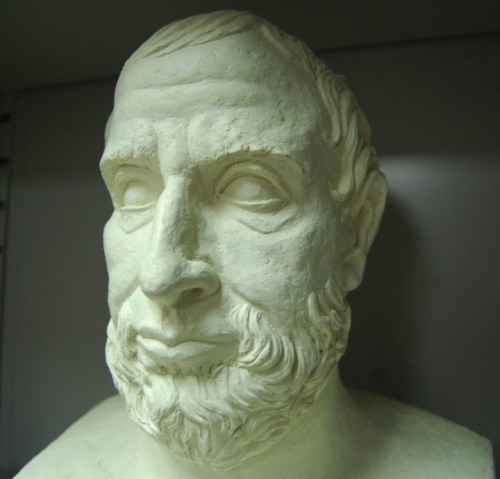
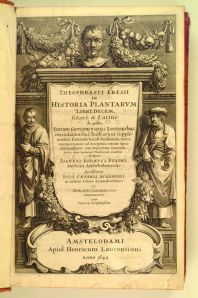
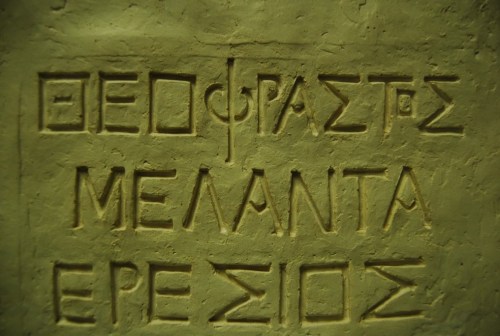
A bit of background on the Project. Bill Fortenbaugh had a grand idea back in the 70s: to set up an international collaborative venture, one that would collect, translate and comment on the surviving texts of the Greek philosophical writer Theophrastus. A native of the town of Eresus on the island of Lesbos, Theophrastus was a pupil of Aristotle and his successor as head of the Peripatetic School. Funding from the National Endowment for the Humanities got the ball rolling for the new Project Theophrastus, and the rest—as they say—is history.

theophrastusinscription

One important way that the Project then moved forward was through international biennial conferences—an unbroken chain from 1979 to the present, with more in store. Continue reading

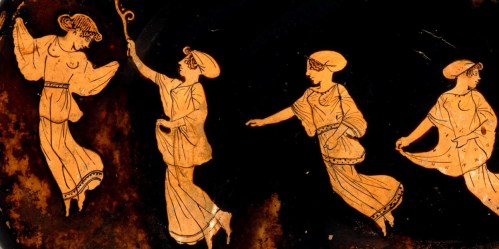
New at RU, Thursday 26 Feb: Harvard’s G.F. Pinney sheds light on “The Dancers on the Acanthus Column at Delphi”

dm13

Not attending the 2009 annual meeting of the College Art Association next weekend in Los Angeles?

Well, then come by the Rutgers Student Center (126 College Avenue, New Brunswick) on Thursday 26 February at 4.30 PM.  The room? There are three of them in fact, because we’re expecting a capacity crowd: 411 ABC.

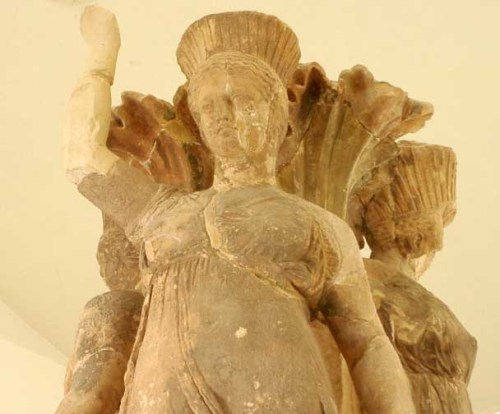
There Harvard’s Gloria Ferrari Pinney will lecture on the “Column of the Dancers”, now in the spectacular museum at Delphi in Greece.

That’s a column, carved from high-grade marble, that features on its upper part statues of three dancing young women, with acanthus leaves below.

47
The assemblage is an Athenian offering of the fourth century BC to the sanctuary Originally it had a tripod on the top—supported by the women’s heads—on which rested a bronze cauldron.

And for this remarkable (and somewhat mysterious) work of art Gloria Ferrari Pinney will offer a new interpretation.

dm2

Continue reading