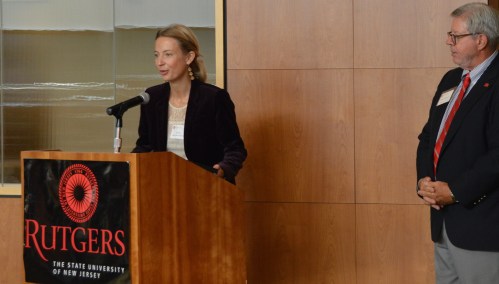
Professor Emily Allen-Hornblower accepts the Chancellor’s Award for Excellence from Rutgers-New Brunswick Chancellor Richard L. Edwards
Here’s another great Rutgers Classics first. Honored in the inaugural group of seven recipients of Rutgers New Brunswick’s important new faculty award—the Chancellor’s Award for Excellence—is Associate Professor in Classics Emily Allen-Hornblower.
In a ceremony Tuesday 4 October 2016, Chancellor Richard L. Edwards recognized Professor Allen-Hornblower in the category of Excellence in Service.
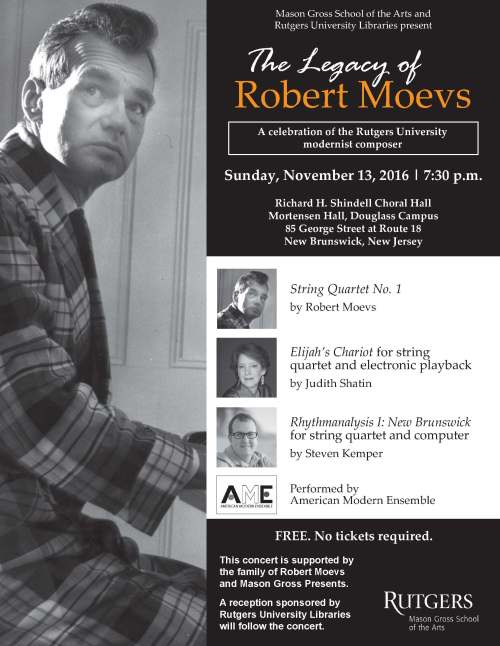
On Sunday 13 November, Mortensen Hall on our Douglass Campus is the venue for a celebration of composer Robert Moevs (1920-2007), husband of noted archaeologist and Rutgers professor emerita of Classics Dr. Maria Teresa Marabini Moevs. The celebratory concert is free and open to the public.
“After serving in World War II as a pilot in the United States Air Force, Moevs’ formative years were spent in Europe… In close contact with the tightly-structured works of Boulez, and stunned by the raw sound of Edgar Varèse, Moevs synthesized these styles into what he termed ‘systematic chromaticism’.” [Baker’s Biographical Dictionary of 20th Century Classical Musicians]. Continue reading →
When it comes to CAAS 2016, all roads lead to New Brunswick
It’s that time again—for one of the most rewarding of academic conferences, the annual fall meeting of the Classical Association of the Atlantic States (CAAS). It all goes down this week with panels, paper sessions, and a performance packed into a very full program on Friday 21 and Saturday 22 October. The location is New Brunswick NJ, at the sleek Heldrich Hotel and Conference Center (10 Livingston Avenue).
As CAAS itself describes it, these “meetings combine scholarly papers on ancient literature, history and archaeology with panels and presentations on the teaching of the Classics, providing a relaxed and enjoyable forum for all college and secondary school teachers who are interested in the Greco-Roman world.”
This year marks the seventh time New Brunswick has hosted the event, but the first in more than a dozen years. (Since its founding in 1907, CAAS has chosen the city as a meeting location in 1923, 1959, 1978, 1983, 1995 and 2002.) The 2016 meeting promises to be a Rutgers reunion of sorts. Spotted on the program alone are about a dozen and a half current and past Rutgers Classics students and faculty. You can see the full program here and an abridged and RU-annotated schedule below. Continue reading →
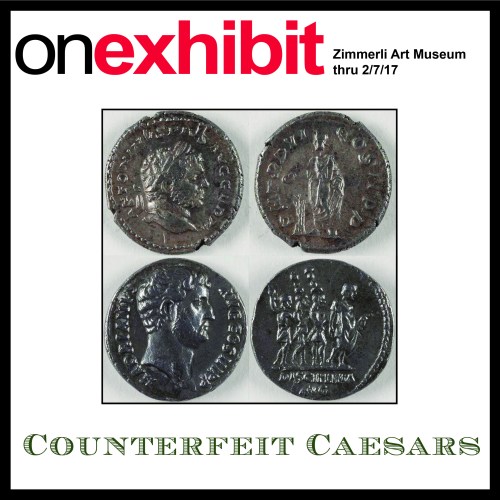
This just in—reposting a welcome press release from Rutgers University Libraries…
“The United States Department of Treasury estimates that about $70 million dollars in counterfeit currency is currently in circulation. Counterfeit money is a tremendous problem in modern economies, but it is not a new problem by any stretch of the imagination.
“While the gallery is dedicated to showcasing works that supplement Rutgers academic courses, it is open to all visitors. Currently, the Study Gallery also includes a display of American prints and an ACT UP Art Box.
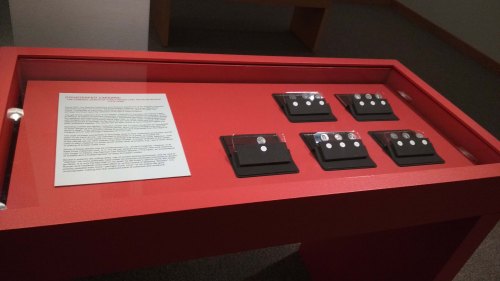
‘Counterfeit Caesars’ on display at the Zimmerli. Credit: Tim Corlis
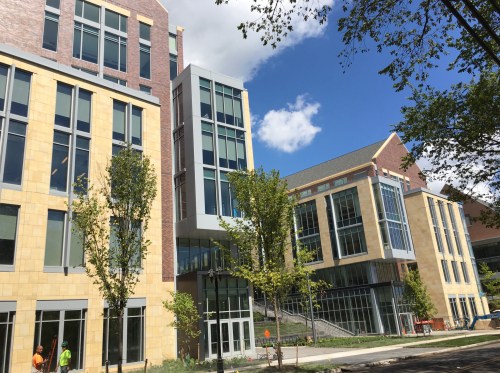
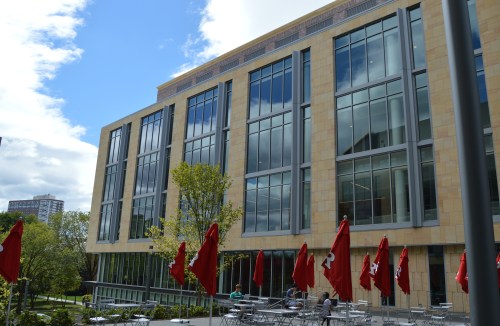
The new Rutgers Academic Building, now the home of RU Classics—6th floor, 15 Seminary Place, New Brunswick NJ. Credit: DEVCO
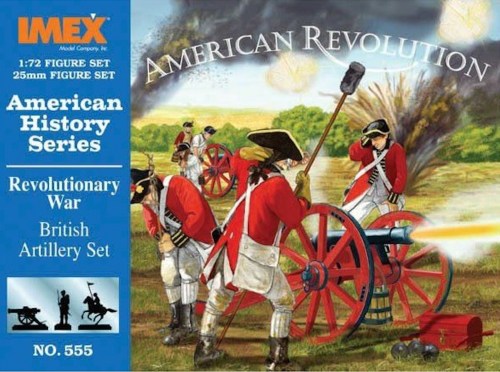
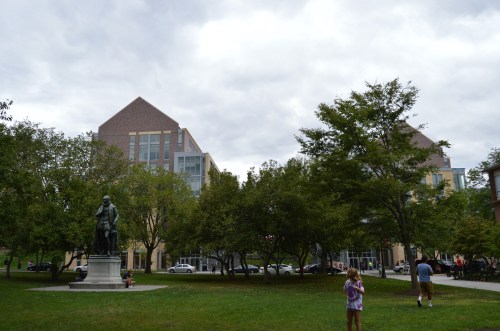
Two hundred forty years ago—in December 1776, during the American Revolution—the British sited their artillery on this hill during their occupation of New Brunswick.
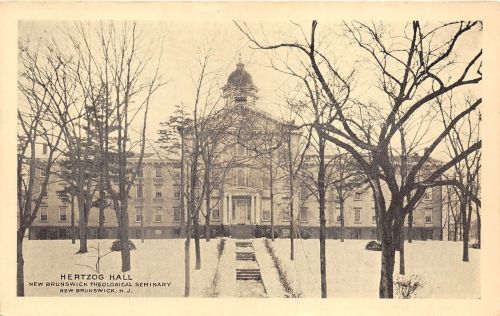
One hundred sixty years ago—in 1856—the New Brunswick Theological Seminary chose the same height for its grand Hertzog Hall, thereby making the hill “holy”.
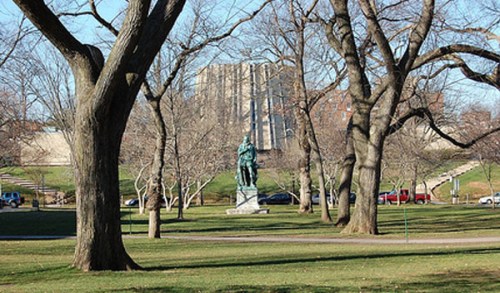
Fifty years ago—in 1966—Hertzog inexplicably fell victim to the wrecking ball, and an architectural monstrosity, Zwemer Hall (charitably known as “The Dixie Cup”) rose up on Holy Hill in its place.
And now on 6 September 2016, on this same elevation Rutgers has opened its $116 million, 175,000 square-foot Academic Building. It serves as new home to its School of Arts and Sciences and a number of SAS departments—including Classics. It marks the first new academic facility on the Rutgers College Avenue Campus since the 1960s.
For Rutgers Classics, it meant saying goodbye to its home (of half a century or so) in the Ruth Adams Building of beloved Douglass Campus, and setting up shop at the following new address:
Department of Classics, Rutgers Academic Building, Room 6183
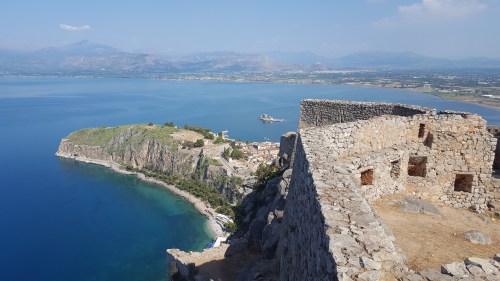
The Palamidi Fortress in Nafplio. Credit (for this and all photos): Emmanuel Aprilakis
Emmanuel Aprilakis is much looking forward to his second year as a graduate student in the Rutgers Classics department, having earned his B.A. summa cum laude from the Macaulay Honors College at CUNY Hunter College in 2015. He is mainly interested in Greek literature and religion with a focus on Attic drama. Emmanuel’s broader research interests include ancient epic, comparative mythology, ancient athletics, sculpture, vase painting, and museum ethics.
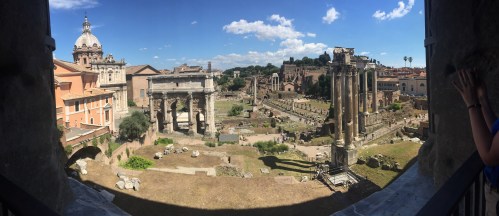
Roman Forum, looking E from the Tabularium. Credit: Alicia Matz
Alicia Matz is entering her second year in the Rutgers Classics graduate program, having earned a 2015 BA in Classics from the University of Puget Sound (Tacoma WA). Her research interests encompass both the Greek and Roman worlds, ranging from Aristophanic comedy, to Augustan literature and material culture, to reception of the classical past, especially in science fiction and fantasy literature.
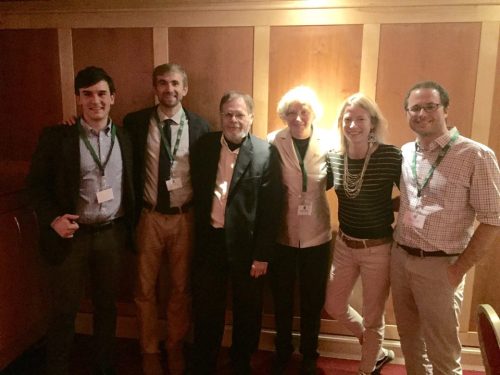
In Dublin’s St. Helen’s Hotel (24 June 2016), RU Celtic Conference presenters (from left) Steve Brandwood, Brian Hill, Prof. Thomas Figueira, Prof. Sarolta Takács, Prof. Emily Allen-Hornblower, and Dave Wright
In the panel, Figueira was joined in presenting a paper (“Language as a Marker of Ethnicity in Herodotus & Contemporaries”) by Associate Professor of Classics Emily Allen-Hornblower with “Emotion and Ethnicity in Herodotus’ Histories”, and Professor of History Sarolta Takács (a member of the Classics Graduate Committee and Director of the Modern Greek Studies Program) with “Herodotus’ (After)life in Byzantium”. Rutgers Classics doctoral Candidates Steven Brandwood (“Ethnicity and Translation”) and Brian Hill (“Protocols of Ethnic Specification in Herodotus”) also presented.
This panel is part of a larger initiative to strengthen intellectual dialogue between Lusophone classicists and ancient historians in Portugal and Brazil and North Americans.
Among Anglophone participants were Renaud Gagné (Cambridge), Rosaria Vignolo Munson (Swarthmore), and Gregory Nagy (Harvard). The videocast of a paper by Gregory Nagy and colloquium with the participants in the panel can be viewed below.
Distinguished alumnae were also presenters (in the panel Modern[Ancient] Epic): Janice Siegel PhD’94 (Associate Professor of Classics, Hampden-Sydney College) with “Apollonius’ Argonautica and the Wizard of Oz” and Liz Gloyn PhD’11 (Lecturer in Classics, Royal Holloway College, University of London) with “Release the Kraken? Ancient Monsters in Modern Epic”.
For full details on the proceedings of the conference, see here (pp. 17-20, 23-24).
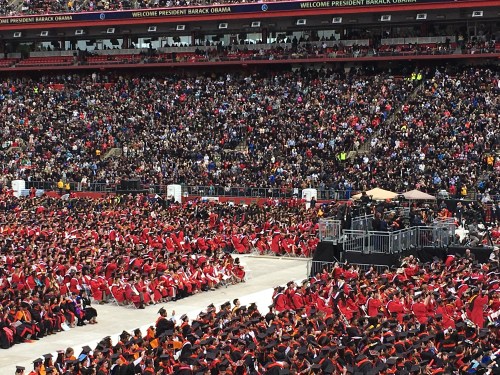
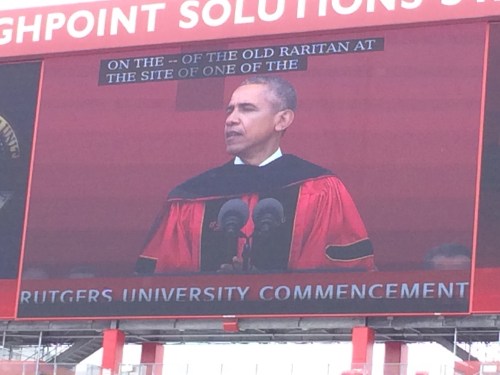
It was a B1G day on the Banks for RU Classics on 15 May 2016 as Rutgers celebrated a super-commencement to mark its 250th anniversary! The site? Rutgers’ High Point Solutions Stadium, where approximately 52,000 people, including more than 12,000 graduates seated on the field, took in the pageantry and proceedings.
President Barack Obama received an honorary degree and delivered a riveting 45-minute address, in which—among many other points—he referenced the pub where our Department got its start in 1771.
View of the President’s speech from the faculty section. Credit: Emily Allen-Hornblower
Congratulations to our Classics majors who received their degrees with the Class of 2016 at the School of Arts and Sciences Convocation that immediately followed the Commencement: Jessica Bailey, Matthew Klein, Oleksiy Lunhu, Daniel McCann, Margaret Morris, Michael Romero, Thi Trinh, Arya Vaseghi (who earned Departmental Honors), and Jennifer Yook.
And additional congratulations to our new PhD Katheryn Whitcomb, who joins the Classics faculty of Franklin & Marshall College next year as a visiting assistant professor. In the proceedings doctoral candidate David Wright also received a much-prized distinction, the degree of M. Phil.
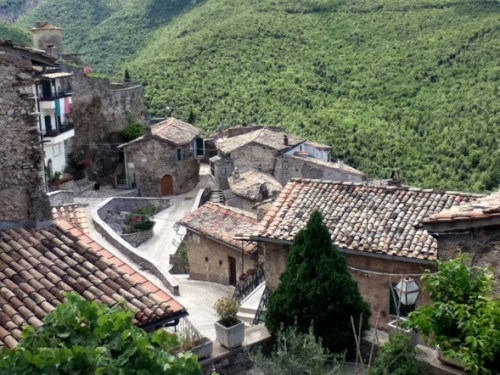
The site could hardly be more evocative. It lies in the Tiber river valley in the northwestern part of the province of Lazio, about 40 miles upriver from Rome. Participants live and work near the small village of Vacone, excavating a Roman villa site with evidence of Republican, Imperial and post-antique occupation and activity. You can read all about it here.
So warm (indeed wild) congratulations are in order for three of our Rutgers—New Brunswick Classics undergraduate students, who will join the field school this summer: Jonathan Finnerty’17, Shannon Gilbert’18, and Molly Kuchler’18. Continue reading →


 rutgersclassics.com